Text to speech providers compared: cost, quality and latency in 2026
A TTS API comparison for 2026: ElevenLabs, OpenAI, Google, Amazon Polly, Azure, Inworld, Cartesia and Deepgram on price, quality, latency and licensing.
Choosing a text to speech API in 2026 comes down to three trade-offs: how natural the voice sounds, how quickly the first audio arrives, and what you pay per million characters. Expressive premium models from ElevenLabs, Inworld and Cartesia lead on realism and real-time speed, while the big cloud platforms (Google, Amazon and Microsoft) win on price at scale, language coverage and enterprise features. This TTS API comparison sets out each provider’s published pricing and features so you can shortlist the right one for your use case.
A quick note before we start. Everything below is based on each provider’s own published pricing pages and documentation, checked in October 2026. We haven’t benchmarked these services ourselves, and prices change often, sometimes several times a year, so always confirm on the provider’s site before you commit.
What to compare in a text to speech API
Before looking at providers, know which questions matter:
- Pricing model. Most providers charge per character of input text. Some newer, LLM-based models charge per token instead, which makes direct comparison harder. Watch for free tiers, volume discounts and the difference between “standard” and “premium” voices on the same platform.
- Quality. Naturalness, emotional range and how well the voice handles tricky text (names, numbers, abbreviations).
- Latency and streaming. For voice agents and live conversation, time to first audio matters more than anything else. Look for streaming or WebSocket APIs and published time-to-first-byte figures.
- Languages and accents. Headline language counts vary a lot in quality. Check the specific languages you need.
- Voice cloning and custom voices. Some providers offer instant cloning from a short sample; others require an application process or a managed engagement.
- Licensing and commercial use. Some free tiers are non-commercial. Consent rules for cloned voices and AI disclosure requirements also differ.
The major providers in 2026
ElevenLabs
ElevenLabs is the name most people know, and it’s the benchmark many teams use when they search for ElevenLabs alternatives. In late September 2026 it launched Eleven v4, which it describes as its most emotive model, alongside a low-latency v4 Turbo variant aimed at voice agents.
- Pricing (as of October 2026): the API pricing page lists $0.08 per 1,000 characters for v4, v3 and Multilingual v2, and $0.04 per 1,000 characters for the faster v4 Turbo, v3 Conversational and Flash/Turbo models. Subscriptions run from a free tier through Starter ($6/month) up to Business ($990/month).
- Quality: widely regarded as one of the most expressive options, with audio tags for fine control over delivery.
- Latency: ElevenLabs quotes around 100ms for v4 Turbo and around 75ms for Flash, with WebSocket streaming available.
- Languages: 90+ for v4 and v4 Turbo; fewer on older models.
- Voice cloning: instant cloning from the Starter plan, professional cloning from Creator upwards.
- Licensing: ElevenLabs says the free plan has no commercial licence and requires attribution if you publish; paid plans include a commercial licence.
OpenAI
OpenAI offers text to speech through its API alongside its language models, which makes it convenient if you already build on its platform.
- Pricing (as of October 2026): tts-1 is $15 per million characters and tts-1-hd is $30 per million characters. The newer gpt-4o-mini-tts model is billed by tokens ($0.60 per million text input tokens and $12 per million audio output tokens), which OpenAI has estimated at roughly 1.5 cents per minute of audio.
- Quality: gpt-4o-mini-tts can be steered with plain-language instructions about tone and delivery.
- Latency: streaming is supported, so playback can begin before the full file is generated.
- Languages: OpenAI says language support broadly follows its Whisper model, covering 50+ languages, although the 13 built-in voices are optimised for English.
- Voice cloning: the documentation describes custom voices created from a speaker’s consent recording, subject to eligibility requirements.
- Licensing: OpenAI’s usage policies require you to clearly tell end users that the voice they’re hearing is AI-generated.
Google Cloud Text-to-Speech
Google offers a wide spread of voice tiers, from very cheap legacy voices to its LLM-based Gemini TTS models.
- Pricing (as of October 2026): Chirp 3: HD voices cost $30 per million characters, with the first million characters each month free. Standard and WaveNet voices are $4 per million (first 4 million free), Neural2 is $16 per million and Studio voices are $160 per million. Instant Custom Voice is $60 per million. Gemini TTS models are billed per token.
- Quality: Chirp 3: HD is Google’s most natural tier for most uses; the older tiers sound noticeably more synthetic.
- Latency: Chirp 3: HD supports streaming synthesis.
- Languages: Chirp 3: HD covers 60+ languages and regional variants.
- Voice cloning: Instant Custom Voice creates a custom voice from a short recording.
- Licensing: standard Google Cloud terms; usable in commercial products.
Amazon Polly
Polly is the workhorse of AWS, popular for IVR systems, e-learning and anything already running on Amazon’s cloud.
- Pricing (as of October 2026): Standard voices are $4 per million characters, Neural $16, Generative $30 and Long-Form $100. There’s a free tier, including 5 million standard characters a month, and AWS notes you can cache and replay generated speech at no extra cost.
- Quality: the Generative engine is Polly’s most human-sounding; Long-Form voices are designed for extended narration.
- Latency: real-time synthesis, widely used for telephony and apps.
- Languages: dozens of voices across a broad range of languages.
- Voice cloning: no self-serve cloning; Brand Voice is a managed engagement with the Polly team to build an exclusive voice.
- Licensing: standard AWS terms. Full SSML support is a strength for developers who want fine control.
Microsoft Azure AI Speech
Azure is a strong choice for enterprises that need broad language coverage, compliance features and deep SSML control.
- Pricing (as of October 2026): Azure’s published retail rates (US East) are $15 per million characters for standard neural voices, $22 per million for Neural HD voices and $24 per million for custom and personal voices. There’s a free tier of 0.5 million characters a month, and commitment tiers bring the price down at volume.
- Quality: HD voices aim for higher realism; standard neural voices are solid and consistent.
- Latency: real-time synthesis through the Speech SDK and REST API, plus a batch API for long audio such as audiobooks.
- Languages: standard voices cover 100+ languages and locales.
- Voice cloning: custom voice (professional voice fine-tuning) and personal voice are available under Microsoft’s limited-access programme for responsible use.
- Licensing: commercial use under Azure terms, with published guidance on disclosure and voice talent consent. Azure also offers embedded voices that run on device.
Inworld
Inworld started in AI characters for games and now offers a standalone TTS API that has become a popular ElevenLabs alternative for real-time apps.
- Pricing (as of October 2026): Realtime TTS-2 is $25 per million characters on demand, falling with plan size to as low as $5 per million at enterprise volume. Realtime TTS-2 Flash is $15 per million on demand and cheaper on higher tiers.
- Quality: TTS-2 supports natural-language steering, such as bracketed instructions to whisper or sound excited.
- Latency: Inworld’s documentation quotes server-side time to first audio of around 100ms for TTS-2 and around 20ms for TTS-2 Flash (excluding network time).
- Languages: Inworld lists support for 200+ languages and locales; as with any provider, quality varies, so test the ones you need.
- Voice cloning: instant cloning on both models, with professional cloning in beta on TTS-2.
- Licensing: Inworld’s pricing page lists a commercial licence on all plans.
Cartesia
Cartesia focuses on low-latency, real-time voice, and its Sonic models are a common pick for voice agents.
- Pricing (as of October 2026): credit-based, where 1 credit equals 1 character. Plans run from Free (20,000 credits a month) to Pro ($5), Startup ($49 for 1.25 million credits) and Scale ($299 for 8 million credits). That works out at roughly $37 to $50 per million characters on the paid tiers, before enterprise discounts.
- Quality: the latest model, Sonic 3.6, adjusts pacing and intonation to the emotional context of the text.
- Latency: built specifically for real-time streaming.
- Languages: 44 languages.
- Voice cloning: instant cloning from Pro, professional cloning from Startup.
- Licensing: a commercial licence starts on the Pro plan.
Deepgram Aura
Deepgram is best known for speech recognition, and its Aura TTS models are designed to pair with it in voice agents.
- Pricing (as of October 2026): Aura-2 is $0.030 per 1,000 characters pay-as-you-go ($30 per million), or $0.027 on the Growth plan. Aura-1 is half that. New accounts get $200 in free credit.
- Latency: Deepgram quotes sub-200ms latency.
- Languages: seven (English, Spanish, Dutch, French, German, Italian and Japanese).
- Voice cloning: not a headline feature.
- Licensing: commercial use under Deepgram’s terms.
What happened to PlayHT?
PlayHT was a popular ElevenLabs alternative, but Meta acquired its parent company, PlayAI, in July 2025, and the standalone service has since been wound down. If you have an older integration, it’s time to migrate.
TTS API comparison table
Prices are the lowest published pay-as-you-go rate for each provider’s flagship natural voice, per million characters, as of October 2026. Volume discounts can be substantial.
| Provider | Flagship price per 1M chars | Real-time streaming | Languages (flagship) | Voice cloning | Best known for |
|---|---|---|---|---|---|
| ElevenLabs | $80 (v4), $40 (Turbo/Flash) | Yes | 90+ | Instant and professional | Expressive, emotive voices |
| OpenAI | $15 to $30, or token-based | Yes | 50+ | Consent-based custom voices | Convenience with OpenAI stack |
| Google Cloud | $30 (Chirp 3: HD) | Yes | 60+ | Instant Custom Voice | Free tier, wide tier range |
| Amazon Polly | $30 (Generative) | Yes | Dozens | Managed Brand Voice | AWS integration, SSML |
| Microsoft Azure | $15 to $22 | Yes | 100+ | Limited access | Enterprise and language breadth |
| Inworld | $25 (TTS-2), $15 (Flash) | Yes | 200+ listed | Instant and professional (beta) | Low latency, price at scale |
| Cartesia | About $37 to $50 via credits | Yes | 44 | Instant and professional | Real-time voice agents |
| Deepgram Aura | $30 (Aura-2) | Yes | 7 | Not a focus | Pairing with speech recognition |
How to choose the best text to speech API for your use case
There isn’t a single best text to speech API. It depends on what you’re building.
Real-time conversation and voice agents
When a person is waiting for a reply, every hundred milliseconds counts. Shortlist the providers that publish low time-to-first-audio figures and offer WebSocket streaming: Inworld (TTS-2 Flash), ElevenLabs (Flash or v4 Turbo), Cartesia and Deepgram Aura. Test from the region your users are in, because network time often outweighs model latency.
Long-form narration, audiobooks and video
For narration, quality and consistency over long passages matter more than speed. ElevenLabs v4 and Inworld TTS-2 are strong on expressiveness. Azure’s batch synthesis and Polly’s Long-Form voices are built for long audio. Whatever you choose, it’s worth reading up on how to make text to speech sound more natural, because how you write the script makes as much difference as which model reads it.
Budget at scale
If you’re generating millions of characters a month, small per-character differences add up fast. The legacy tiers on Google and Polly (around $4 per million) are the cheapest, though they sound more synthetic. Among natural-sounding voices, Inworld’s volume pricing, Azure’s commitment tiers and Deepgram Aura are worth comparing.
On-device and offline
If you need speech without a network connection, or you can’t send text to the cloud, look at on-device options:
- Built-in system voices on Android and iOS are free and work offline.
- Azure embedded voices run on device for supported scenarios.
- Open-weight models such as Kokoro-82M (Apache 2.0 licence) can run locally. Piper is another popular local engine, but its current repository is GPL-licensed and individual voices carry their own licences, so check each voice’s model card before commercial use.
Cloning and custom brand voices
If you need a unique voice, compare consent and access requirements as well as price. ElevenLabs, Cartesia and Inworld offer self-serve instant cloning. Google offers Instant Custom Voice, OpenAI requires a consent recording, Azure uses a limited-access application, and Polly’s Brand Voice is a managed project. If you’re working with voice actors, our guide to AI voices in games and adverts covers consent and union agreements.
If you don’t want to build anything
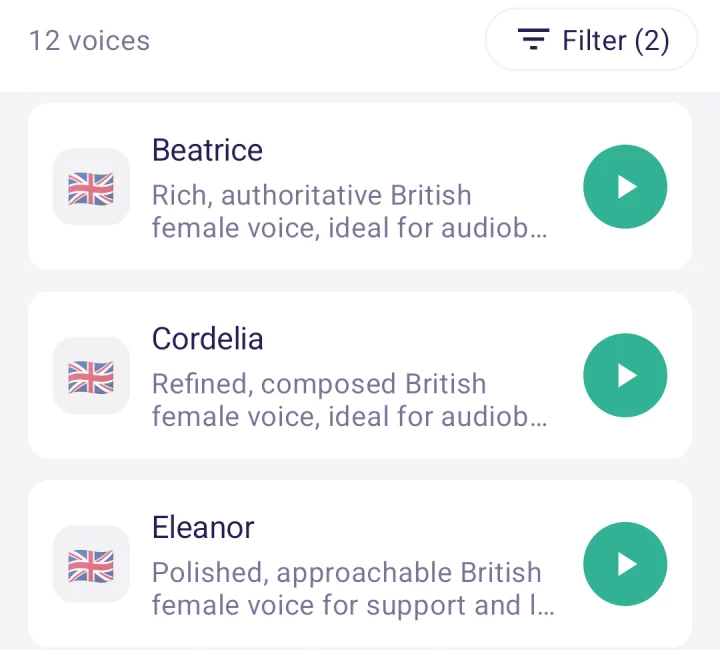
Not everyone needs an API. If you simply want to type and hear natural AI voices, or download a clip for a video, an app that packages them up is far quicker. MyVoice, for example, gives you 278 natural AI voices across 15 languages in an Android app, with audio clip downloads on paid plans. You can hear every voice on our homepage, and our roundups of the most realistic AI voices and the best text to speech apps cover other ready-made options.
FAQ
What is the cheapest text to speech API?
On published pay-as-you-go rates, Google’s Standard and WaveNet voices and Amazon Polly’s Standard voices are the cheapest at around $4 per million characters (as of October 2026), with generous free tiers. They sound less natural than premium models, though.
What are the best ElevenLabs alternatives?
It depends on why you’re switching. For lower latency and lower cost at volume, Inworld and Cartesia are common choices. For enterprise compliance and language breadth, Azure and Google. For pairing TTS with speech recognition in a voice agent, Deepgram.
Which TTS API has the lowest latency?
Inworld, ElevenLabs, Cartesia and Deepgram all publish real-time figures in the tens to low hundreds of milliseconds, but they measure it differently.
Can I use AI voices commercially?
Usually, on paid plans. Some free tiers (ElevenLabs, for example) are non-commercial and require attribution, and some providers require you to disclose that voices are AI-generated. Always read the provider’s current terms.
How often do TTS API prices change?
Often. Several providers here launched new models in 2026 alone, so check the provider’s pricing page before you commit.
Download MyVoice
Try for free
Natural AI voices, saved phrases, and full accessibility support on iOS and Android.